Timer/Counter & Input Capture
Table of contents
- Overview
- Calculation
- Worked Example
- Capture and Overflow
- Update and Verification
- Timer/Counter Configuration
- S32K312 Setup Checklist
- Wrap-safe Elapsed Time in C
- Capture Data Path
- Timer Verification
Overview
Timer는 주기 작업·timeout·PWM·edge timestamp의 기반이다. S32K312에서 사용할 timer IP와 channel·pin은 RTD 예제와 Reference Manual로 확정한다. 서로 다른 timer의 prescaler·reload 의미를 혼용하지 않는다.
Calculation
상향 카운터가 0부터 MOD까지 포함하고 한 주기에 한 번 반복하는 모델이면 f_tick=f_input/divider, period=(MOD+1)/f_tick이다. Center-aligned PWM은 카운트 왕복과 endpoint 처리에 따라 식이 달라진다. Duty 0/100%의 compare 특수 동작도 확인한다.
Worked Example
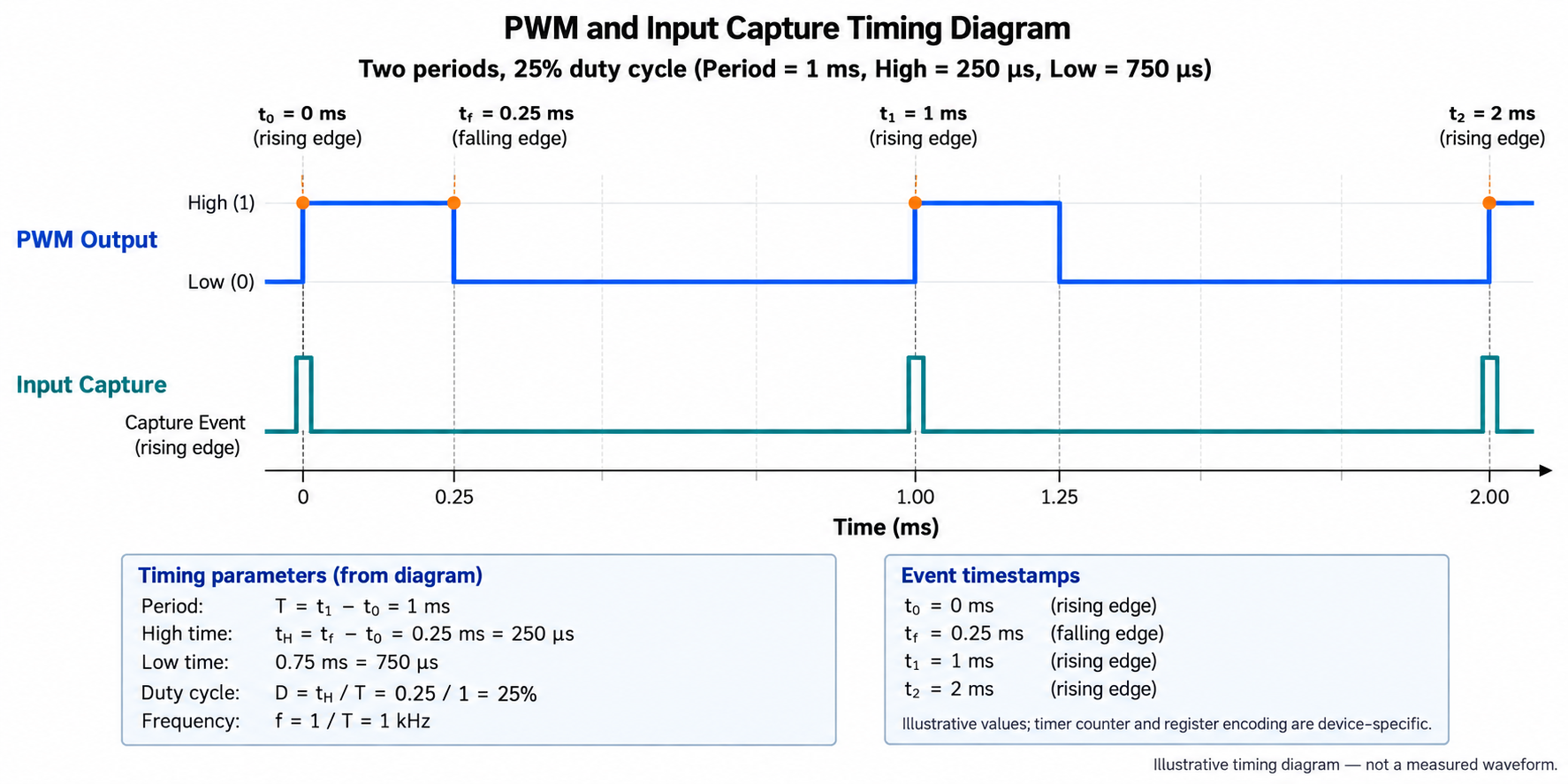
그림 읽기와 실측 확인: 실제 scope에서 period·High time·jitter를 확인한다. timer tick 단위, counter wraparound, edge polarity를 기록하고 center-aligned PWM에는 같은 계산식을 그대로 적용하지 않는다.
설명용 입력 80 MHz, divider 80이면 tick은 1 us다. MOD=999이면 period는 1 ms, frequency는 1 kHz다. edge-aligned high time 250 tick을 지원하는 설정이면 25% duty다. 실제 레지스터가 divider 자체인지 divider−1인지 확인한다.
Capture and Overflow
입력 capture는 edge 시각을 하드웨어에서 기록하여 ISR 진입 지연의 영향을 줄인다. 같은 timer의 unsigned 차이로 짧은 간격을 계산할 수 있지만 한 번 이상 wrap되는 긴 구간에는 overflow 확장 counter가 필요하다. 측정 주파수와 duty를 edge polarity별로 구분한다.
Update and Verification
PWM compare를 주기 중간에 바꾸면 glitch가 생길 수 있으므로 shadow register와 reload 시점을 확인한다. scope로 frequency·duty·jitter·0/100%·runtime update와 저전력 복귀를 검증한다. ISR에서 긴 작업 대신 event만 전달한다.
Timer/Counter Configuration
| 기능 | 설정과 적용 예 |
|---|---|
| Periodic timer | Clock·prescaler·reload·IRQ를 설정해 주기 event를 만든다. ISR에서 긴 작업을 하지 않는다. |
| Free-running counter | Timestamp·timeout에 사용한다. Counter 폭과 wrap 주기를 명시한다. |
| External event counter | 외부 pulse 입력·edge·filter·최대 input rate를 확인한다. 모든 timer가 지원하지는 않는다. |
| Input Capture | rising/falling edge의 counter 값을 latch하여 period·pulse width를 계산한다. |
| Output Compare | Counter match로 event/output을 만든다. PWM은 별도 PWM 문서에서 다룬다. |
S32K312 Setup Checklist
사용 목적을 먼저 정하고 해당 S32K312/RTD에서 지원하는 timer IP를 선택한다. Clock source·gate·divider → counter mode·reload → channel/pin → event routing·IRQ/DMA → 시작 순서로 구성한다. Core clock을 timer 입력으로 가정하지 않는다. Compare/capture flag의 clear 방식과 freeze/debug/low-power 동작을 확인한다.
Wrap-safe Elapsed Time in C
32-bit free-running counter의 두 관측 사이에 최대 한 번 wrap되고 실제 간격이 2^32 tick 미만인 경우 unsigned subtraction으로 elapsed를 계산할 수 있다. 16-bit timer를 32-bit 변수에 읽었다면 별도 16-bit modular 연산이나 overflow 확장이 필요하다.
#include <assert.h>
#include <stdbool.h>
#include <stdint.h>
static bool expired(uint32_t now, uint32_t start, uint32_t timeout) {
    return (uint32_t)(now-start) >= timeout;
}
int main(void) {
    assert((uint32_t)(0x10u-0xfffffff0u)==32u);
    assert(expired(0x10u,0xfffffff0u,32u));
    assert(!expired(0x0fu,0xfffffff0u,32u));
    return 0;
}
한 번 이상의 full counter cycle 동안 상태를 확인하지 않으면 이 함수만으로 실제 경과시간을 복원할 수 없다. Overflow ISR과 high word를 조합할 때도 capture와 overflow가 동시에 발생하는 race를 처리해야 한다.
Capture Data Path
Edge timestamp를 ISR에서 소프트웨어로 읽는 것과 hardware capture register를 읽는 것은 다르다. Hardware capture도 다음 edge가 오면 덮어쓸 수 있으므로 FIFO/DMA·overcapture flag를 확인한다. CPU가 읽는 순서와 flag clear가 캡처 데이터를 버리지 않는지 확인한다.
Timer Verification
기준 신호로 period·pulse width·wrap 경계·누락된 edge·IRQ 지연·저전력 복귀를 시험한다. 32-bit 1 MHz counter는 약 71.6분마다 wrap된다. Counter 폭과 tick frequency가 바뀌면 timeout의 유효 범위도 다시 계산한다.